Showing posts with label women travel. Show all posts

Thursday, March 26, 2026

Hotels, Not Airbnb

 Hotels, Not Airbnb

In an age in which Airbnb has become almost synonymous with modern travel, my own preference remains decidedly old-fashioned: I choose hotels. This is not the result of habit, resistance to change, or a failure to appreciate the appeal of private rentals. I understand the allure perfectly well. Airbnb promises intimacy, novelty, and the seductive idea that one is not merely visiting a place, but inhabiting it. For many, that is part of the romance. Yet after decades of traveling alone throughout the world, I have come to trust something less romantic and far more enduring: the value of professional hospitality.


Travel, especially solo travel, is often idealized as an expression of pure freedom. And it is. But those who travel alone for long enough come to understand that freedom is sustained not by improvisation alone, but by wise structures. Where one stays is not incidental. It shapes the entire emotional and practical architecture of a journey. Lodging is not simply a backdrop to travel; it is the place to which one entrusts one’s rest, one’s safety, one’s belongings, and, in subtle ways, one’s peace of mind.


That is why I have never stayed in an Airbnb.


For me, the matter begins with security, but it does not end there. A hotel offers an ecosystem of reliability that private rentals rarely equal: a staffed front desk, a concierge, on-site maintenance, housekeeping, and the reassuring knowledge that when something goes wrong, one is not left to negotiate alone with distance, delay, or uncertainty. This matters profoundly when one is traveling independently, especially in unfamiliar cities or foreign countries. The older I become, and the more I travel, the more I value not just beauty or convenience, but accountability.


There is a particular kind of exhaustion that can accompany travel, even joyful travel: delayed flights, unfamiliar transit systems, language barriers, sudden illness, a misread map, a neighborhood that feels different at night than it did in the afternoon. In such moments, a hotel is more than lodging. It is a point of orientation. It is a place where help exists not as an abstraction, but as a person standing a few feet away. That, to me, is not a minor luxury. It is part of traveling intelligently.


I also remain unconvinced by the notion that an Airbnb necessarily offers a more authentic encounter with place. Authenticity, as travelers often invoke it, can be a misleading ideal. One does not come to know a city merely by sleeping in someone else’s apartment. A city reveals itself through attention, movement, conversation, observation, and time. I can stay in an excellent hotel and still walk its neighborhoods, ride its public transportation, browse its markets, sit in its cafés, and absorb its rhythms. In fact, I often do so more confidently because I know I am returning to an environment designed to support the traveler rather than test her endurance.


And support matters to me. I choose hotels in lively, interesting areas, preferably with access to public transportation, because I want both immersion and ease. I want to be able to step into the life of a city while knowing that my return will be straightforward, safe, and comfortable. I appreciate the practical graces that hotels continue to offer without apology: a room that is cleaned each day, fresh towels, breakfast on site when available, and staff who can answer questions no algorithm can fully anticipate. Even extensive research before a trip cannot rival the value of current local knowledge. A seasoned concierge or hotel employee often knows more about what is actually happening in a city that day than any travel forum or guidebook ever could.


This is not simply a matter of convenience. It is a matter of preserving one’s energy for the true purpose of travel. I do not want to spend precious time solving lodging problems, waiting for a host to respond, wondering whether an issue will be fixed, or improvising my way through avoidable complications. I want my attention available for discovery: for museums and neighborhoods, for history and architecture, for unexpected beauty, for the quiet pleasure of being fully present in a place I have never been before.


To say that I prefer hotels is not to disparage those who prefer Airbnb. Different travelers value different things. Some seek domesticity, informality, or the pleasures of temporary habitation. I understand that. But my own travels have taught me that what appears adventurous is not always wise, and what appears conventional is not always unimaginative. Hotels, at their best, offer something deeply underrated in contemporary life: competent care. They make room for independence without requiring unnecessary vulnerability.


Perhaps that is the distinction that matters most. I do not choose hotels because I am fearful. I choose them because experience has refined my understanding of freedom. Real freedom in travel does not come from surrendering oneself to uncertainty for its own sake. It comes from creating the conditions in which one can move through the world with confidence, curiosity, and steadiness. After decades of traveling alone across continents, I have learned that good judgment is not the enemy of adventure. It is what makes adventure sustainable.


So yes, in a cultural moment enamored of Airbnb, I remain loyal to hotels. Not because I lack imagination, but because I have traveled enough to know what serves me best. In the end, I do not need my lodging to perform authenticity. I need it to provide safety, professionalism, local knowledge, and peace. That is not a failure of daring. It is the privilege of experience.


I can also adapt this into a polished letter-to-the-editor, a blog post, or a Facebook post with a more concise but still elegant tone.

Tuesday, March 4, 2025

Advice for First-Time Cruisers to Europe

Advice for First-Time Cruisers to Europe: Embracing History and Culture


For many travelers, their first cruise experience is to the Caribbean, where the focus is often on relaxation, lounging on the beach, strolling around the port, buying souvenirs, and enjoying drinks near the ship. Caribbean cruises are typically about escaping the cold or unwinding in a tropical paradise, rather than immersing oneself in deep historical or cultural exploration.


However, cruising to Europe and other historically rich regions such as Asia, South America, or Oceania offers a completely different experience. These destinations are filled with centuries-old architecture, world-class museums, breathtaking cityscapes, and cultural traditions that have shaped civilizations for millennia. To truly appreciate what these ports have to offer, it’s essential to go beyond the typical cruise mindset of simply stepping off the ship and seeing what’s nearby.


While there’s nothing wrong with choosing to relax on a Mediterranean beach, treating an entire continent as if it were just another Caribbean stop is a missed opportunity. Some travelers may gravitate toward the familiar visiting McDonalds or Starbucks instead of trying local cuisine, or opting for a quick glance at a famous site rather than delving into its history. While this is a personal choice, a little preparation and curiosity can make the experience far more rewarding.


To get the most out of a European cruise, I highly recommend researching each port in advance. Create a list of the top five historical or cultural sites you like to visit, as well as five key facts about the destination. Whether you choose a private tour, a ship-sponsored excursion, or independent exploration, having some background knowledge will deepen your appreciation of what you are seeing. A well-informed local guide can bring history to life, but the experience is even more meaningful when you already have some context.


Destinations Best Explored with a Local Guide


Some places are simply too complex, historically significant, or logistically challenging to fully appreciate without an expert guide. In these locations, investing in a guided tour isn just recommended—it’s essential.


—-Giza & Cairo, Egypt

Seeing the Pyramids, the Sphinx, and the treasures of ancient Egypt is a bucket-list experience, but navigating Cairo can be overwhelming. A local guide provides invaluable insight into the history, culture, and hidden details of these ancient wonders.


—Pompeii & Herculaneum, Italy

These Roman cities were buried in ash when Mount Vesuvius erupted in 79 AD. A knowledgeable archaeologist or historian can help you understand the daily life of ancient Romans and interpret the well-preserved ruins.


—Penguin Rookeries in South America

If you’re visiting penguin colonies in places like the Falkland Islands, Punta Tombo (Argentina), or Magdalena Island (Chile), a naturalist guide ensures you follow conservation guidelines while providing fascinating insights into the penguins’ behaviors and habitats.


—The Acropolis & Athens, Greece

The Parthenon and surrounding structures have centuries of history, mythology, and architectural significance. A professional guide will help you understand their place in Western civilization.


Ephesus, Turkey 

This sprawling ancient city, home to the Library of Celsus and the Great Theatre, is best appreciated with a historian or archaeologist who can bring its ruins to life.


—Petra, Jordan 

The Rose City is an architectural marvel carved into rock, and a guide can explain its Nabatean history, hidden tombs, and religious significance.


—Machu Picchu, Peru

The Incan citadel in the Andes is stunning on its own, but a guide can provide crucial information about its construction, purpose, and rediscovery.


The Great Wall of China

Understanding its vast history, strategic importance, and the different sections worth visiting is best done with a guide.


—Angkor Wat, Cambodia

This massive temple complex has deep religious and historical significance, and a guide helps make sense of its carvings, structures, and layout.


—The Vatican & Sistine Chapel, Italy 

A guided tour is essential to navigate the Vatican Museums efficiently, appreciate Michelangelo’s frescoes, and learn about the historical and religious significance of the artworks.


—Stonehenge, England 

A visit to this ancient monument is enriched by learning about its possible purposes, astronomical alignments, and the Neolithic people who built it.


My personal travel philosophy is simple: I seek out experiences I can’t have at home. That means prioritizing historical landmarks, cultural institutions, and local traditions over beaches, bars, and touristy shopping areas. The more you prepare in advance, the richer your memories will be and the more rewarding your journey will feel.


For me, learning about a destination before I arrive is almost as enjoyable as being there. I encourage all first-time European cruisers to embrace that mindset. A cruise to a region with a deep historical and cultural legacy is an incredible opportunity make the most of it!


About the Author


Karla Scott – A Passionate Explorer and Cultural Enthusiast

Karla Scott is a seasoned traveler with over four decades of solo travel experience, visiting more than 100 countries across six continents. Her love for exploration began during a junior year abroad in Normandy, France, where she discovered the thrill and empowerment of solo travel.


Karla’s journeys have taken her from the ancient ruins of Egypt to the bustling markets of India, the serene fjords of Norway, and beyond. With her extensive travel experience, she has honed her expertise in navigating diverse cultures and solo travel strategies, coaching others on cross-cultural communication and teaching English online.


Her mission is to inspire and empower women to embrace the transformative power of solo travel. Whether you’re a first-time traveler or a seasoned adventurer, Karla’s insights offer the guidance and encouragement you need to step boldly into the world.


More recently, Karla has explored the world through solo cruises, journeying across the Mediterranean, the Caribbean, Northern Europe, and beyond.

Wednesday, November 6, 2024

Prague Day #3

 Last Day in Prague 11-5-24


Today is my last solo day in Prague, wrapping up an unforgettable Central European journey that included a scenic Danube River Cruise. I spent the day riding trams around the city and visiting some of Prague’s iconic sites.
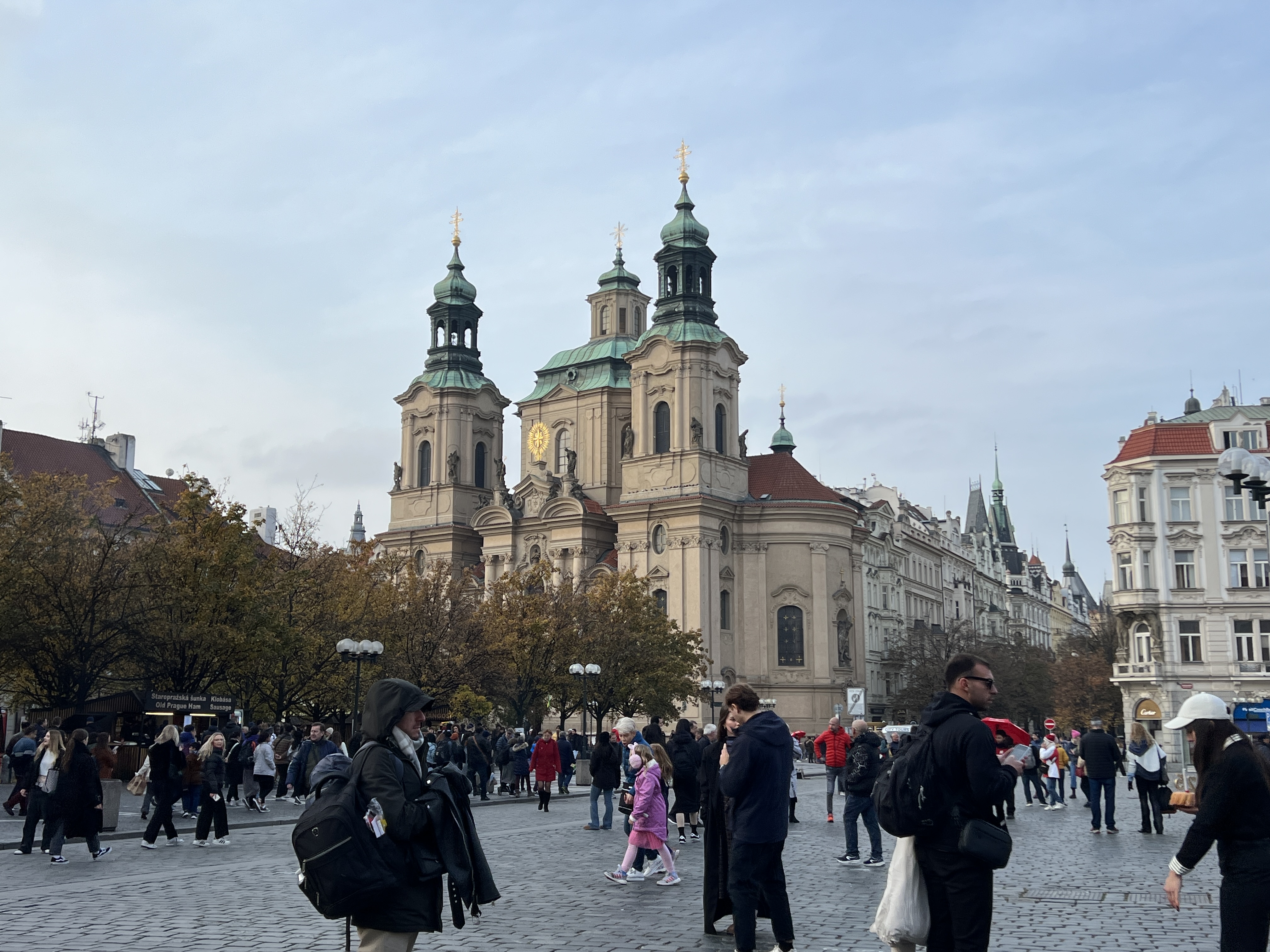
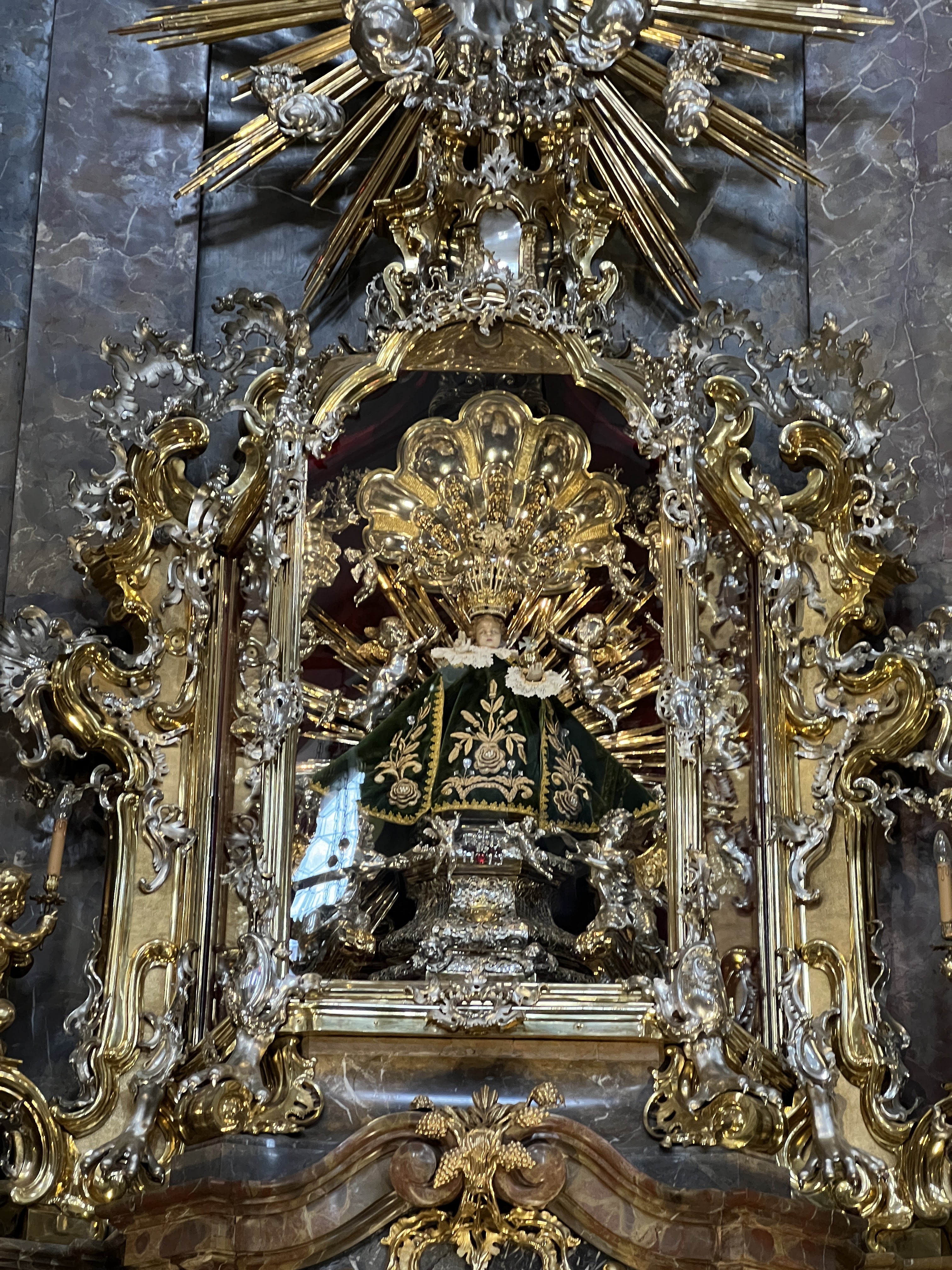
My first stop was the Church of the Infant Jesus in the Lesser Town on the castle side of the river. The church is undergoing a year-long reconstruction to add ramps for improved accessibility. Here, they celebrate the Infant Jesus of Prague, adorned in royal blue and gold robes. Below is the prayer Pope Benedict offered to honor this church in 2009.
Next, I climbed up to visit St. Nicholas Church and then walked across the famous Charles Bridge.
The Charles Bridge is truly one of Prague’s most iconic landmarks. Spanning the Vltava River, it connects the Old Town with the Lesser Town (Malá Strana) and Prague Castle. Built in the 14th century by order of King Charles IV, it features stunning Gothic architecture and is adorned with 30 statues of saints, giving it a timeless, historic charm.
Surprisingly, I ran into several groups from our Danube River Cruise while exploring today. Our last big excursion was yesterday morning, but I saw many familiar faces again over breakfast at the hotel this morning.
For a quick coffee break, I stopped at a “world-famous” café nearby: Starbucks.
My final stop was Wenceslas Square, one of Prague’s main city squares and a vibrant cultural hub. It’s a fantastic place for people-watching and shopping, with plenty of historical significance to soak up.
I used my last Czech currency to buy a magnet and dinner.
I returned to my hotel early tonight to prepare for my 6:55 AM flight tomorrow morning.

PRAYER—English
Prayer of the Pope Benedict XVI to the Infant Jesus of Prague he utered during his visit at the Church of Our Lady Victorious in Prague on the 26th September 2009
O my Lord Jesus,we gaze on You as a child and believe that You are the Son of God, who became Man through the working of the Holy Spirit in the womb of the Virgin Mary.
Just as in Bethlehem, we too, adore You, with Mary, Joseph, the angels and the shepherds, and acknowledge You as our only Savior.
You became poor to enrich us with Your poverty.
Grant that we may never forget the poor and all those who suffer.
Protect our families, bless all the children of the world and grant that the love You have brought us may always reign amongst us and lead us to a happier life.
Grant, O Jesus,
that all may recognize the truth of Your birth, so that all may know that You have come
to bring to the whole human family light, joy and peace.
You are God, who live and reign with God the Father, in the unity of the Holy Spirit, one God, forever and ever.
Amen.
Shrine of the Infant Jesus of Prague Karmelitská 9, Praha 1, CZ, EU
Here is the prayer in the Czech language:
MODLITBA
Modlitba papeze Benedikta XVI. k Prazskému Jezulátku, kterou pronesl pri své návstévé chrámu Panny Marie Vítezné dne 26. zári 2009
Pane Jezísi, máme Te pred ocima jako díté a véríme, ze jsi Bozi Syn, jenz se stal clovekem skrze Ducha svatého v line Panny Marie.
Podobné jako v Betléme i my spolu s Marií a Josefem, andély a pastýri se Ti klaníme a vyznáváme, Ze jsi nás jediny Spasitel.
Stal ses chudým, abychom my zbohatli z Tvé chudoby; dej, at nikdy nezapomínáme na chudé a na ty, kdo trpí.
Ochrañuj nase rodiny, zehnej vsem détem celého svéta a dej, at nám vzdy vládne láska, kterou jsi prinesl, aby cinila nás zivot stastnejsím.
Doprej vsem lidem, Jezisi, aby porozuméli poselství Bozího narození, aby pochopili, ze jsi prisel darovat celé lidské rodiné svetlo, radost a pokoj.
Nebot Ty jsi Büh a zijes a kralujes s Bohem Otcem v jednotē Ducha svatého po vsechny veky vekủ.

Monday, November 4, 2024

Museum of Communism in Prague, Czech Republic.

 “Human rights are universal and indivisible.”

Human freedom is also indivisible: if it is denied to anyone in the world, it is therefore denied, indirectly, to all people. This is why we cannot remain silent in the face of evil or violence; silence merely encourages them.”
——-VÁCLAV HAVEL, the first president of the newly liberated Czechoslovakia who has been previously imprisoned for his anti-Soviet activism. 1989
The people of Czechoslovakia were terrorized and demonized under the Nazis then the Soviets for more than 50 years.
While some other travelers in my group visited the Terezin concentration camp, I decided to learn more about Czechoslovakia’s tumultuous history during the 20th century. I arrived at 5:00 PM and the manager alerted me at 7:50 PM that the museum would close in 10 minutes. Of note, I also spent three hours at the museum of terror in Budapest where I learned about the impact of the brutal Nazi and Soviet regimes on Hungary.
Prior to World War II, Czechoslovakia’s population was roughly one-third Czech and Slovak, one-third German, and one-third Jewish. By the war’s end, the Jewish population had largely been deported and murdered in the Holocaust, while the German population faced expulsion as retribution for Nazi occupation and brutality. This left a population primarily composed of native Czechs and Slovaks.
I went to the Museum of communism in Prague, Czech Republic. Here is a description of the museum from its website:
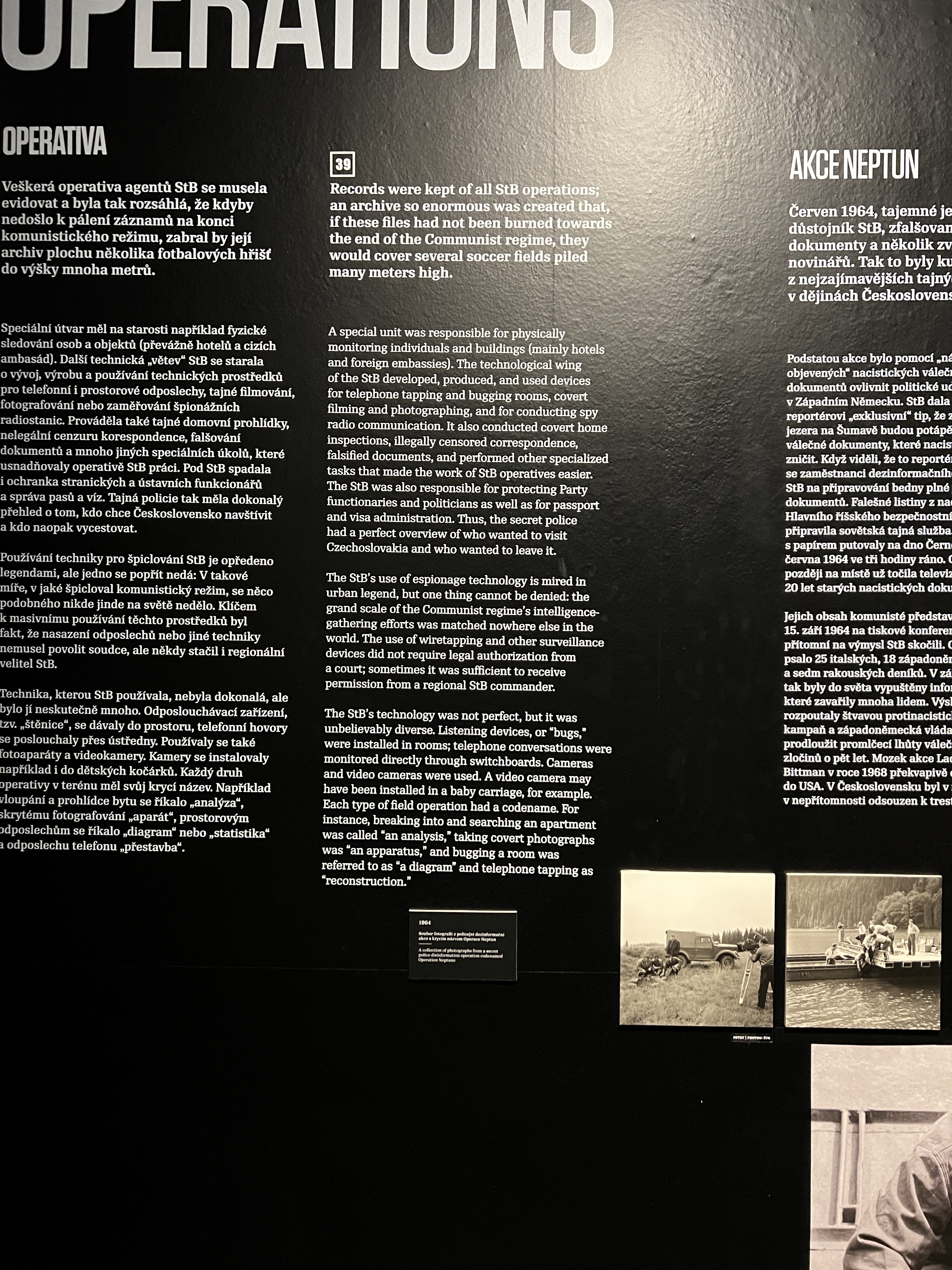
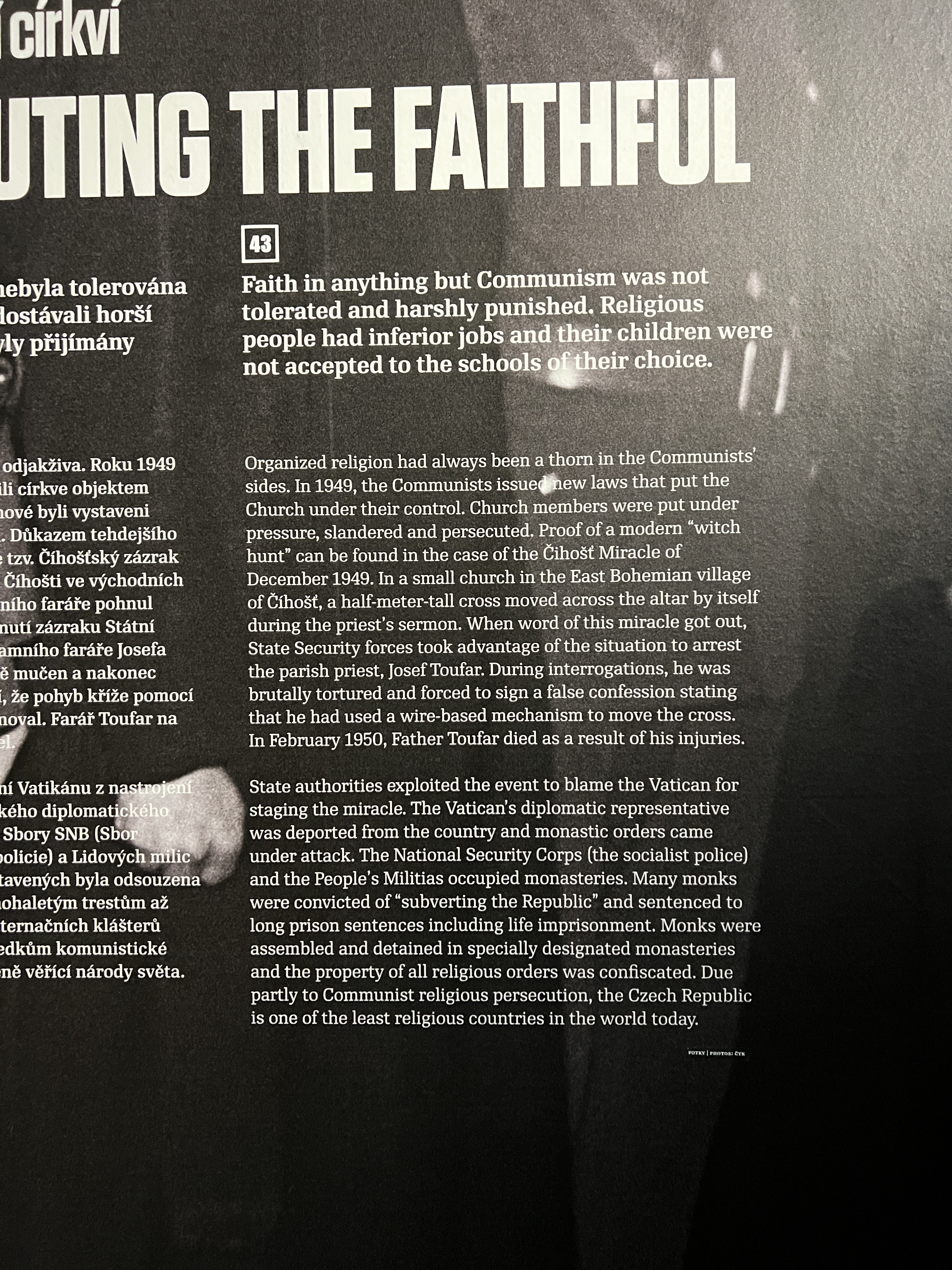
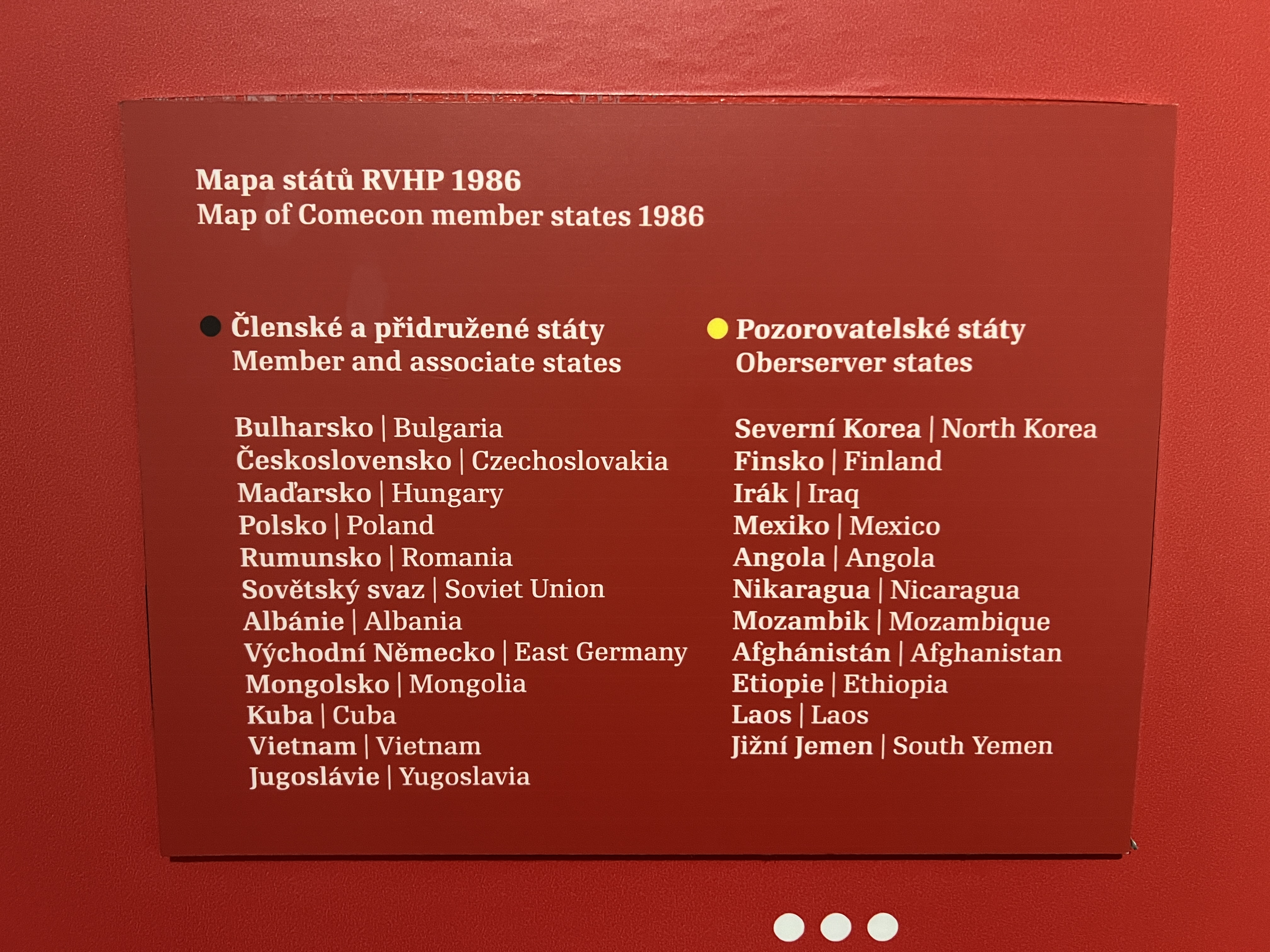
View of the following aspects of life in Communist-era Czechoslovakia: daily life, politics, history, sports, economics, education, art (specifically Socialist Realism), propaganda in the media, the People's Militias, the army, the police (including the secret police, the StB), censorship, and courts and other institutes of repression, including show trials and political labor camps during the Stalinist era. It focuses in particular on the totalitarian regime that ruled the country from the February putsch in 1948 until the Velvet Revolution in 1989.
Housed in a space of nearly 1,500 m2, the museum provides visitors with an authentic feel of the era that is enhanced by the incorporation of short videos, posters, and artifacts. The exhibit includes interestingly designed spaces, where visitors can walk through mock-ups of a shock worker's workshop, a school classroom, a child's bedroom, and an interrogation room. We have also selected interesting items from our vast collection of materials that illustrate what daily life under Communism was like. Everything is described on 62 panels divided into thematic sections, which are enriched with a great amount of photographic material from the Archive of the Czech News Agency, the Security Services Archive, the Archive of the Association of Forced Military Camp Laborers, and the personal collections of leading Czech photographers.
Czechoslovakia’s experience during World War II and the subsequent Soviet occupation was marked by trauma, occupation, and political upheaval. After the Munich Agreement of 1938 allowed Nazi Germany to annex the Sudetenland (which was land on the border of Czechoslovakia with lots of German ) Hitler quickly escalated his ambitions. In March 1939, German forces invaded and occupied the remaining parts of Czechoslovakia, creating the Protectorate of Bohemia and Moravia under strict Nazi control. During this time, resistance was brutally suppressed, and many citizens were imprisoned, sent to concentration camps, or executed, including members of the Czechoslovak resistance and Jewish communities. The assassination of Nazi leader Reinhard Heydrich in 1942 led to horrific reprisals, including the complete destruction of the village of Lidice.
Following the Allied victory in 1945, Soviet troops entered Czechoslovakia, which then fell within the Soviet sphere of influence. The communist coup of 1948 brought Czechoslovakia fully under Soviet-style rule, creating a tightly controlled, one-party state. Life under Soviet-backed communist rule was marked by censorship, restrictions on freedom, and widespread surveillance. The government operated secret police, silencing any form of dissent and promoting a culture of fear, in which even family members could be compelled to report one another. The suppression reached its peak during the Prague Spring of 1968, when Soviet tanks invaded to crush reform movements aimed at creating “socialism with a human face.” The years that followed, known as “Normalization,” saw further repression, purges, and hardship for those who had hoped for a more liberal society. For decades, Czechoslovakians lived under the constant watch of the Soviet-backed state, enduring restrictions on expression, movement, and individual freedoms until the Velvet Revolution of 1989 finally ended Soviet dominance.


Hotels, Not Airbnb

  Hotels, Not Airbnb In an age in which Airbnb has become almost synonymous with modern travel, my own preference remains decidedly old-fash...